AI in Ecommerce 2025: How Artificial Intelligence Will Save Your Business and Boost Profits
“Every 3 out of 5 purchases in 2024 are controlled by AI algorithms,” states a McKinsey report. If this figure seems like science fiction to you, it’s time to reconsider your perspective. AI in ecommerce is no longer a technology of tomorrow. It’s already here, and those who ignore it risk being left behind in the rapidly growing ecommerce sector.
Table 1: “Top 5 Companies Where AI is Already at Work (2024)”
| Company | AI Technologies Implemented | Result |
| Amazon | Personalized recommendations | +35% revenue |
| Alibaba | Demand forecasting (ML) | -30% excess inventory |
| Starbucks | Geolocation-based personalization | +20% average order value |
| H&M | AI chatbots (NLP) | -70% support workload |
| Shopify | Generative AI for content | +22% conversion rate |
The Market in Action: The Numbers Don’t Lie
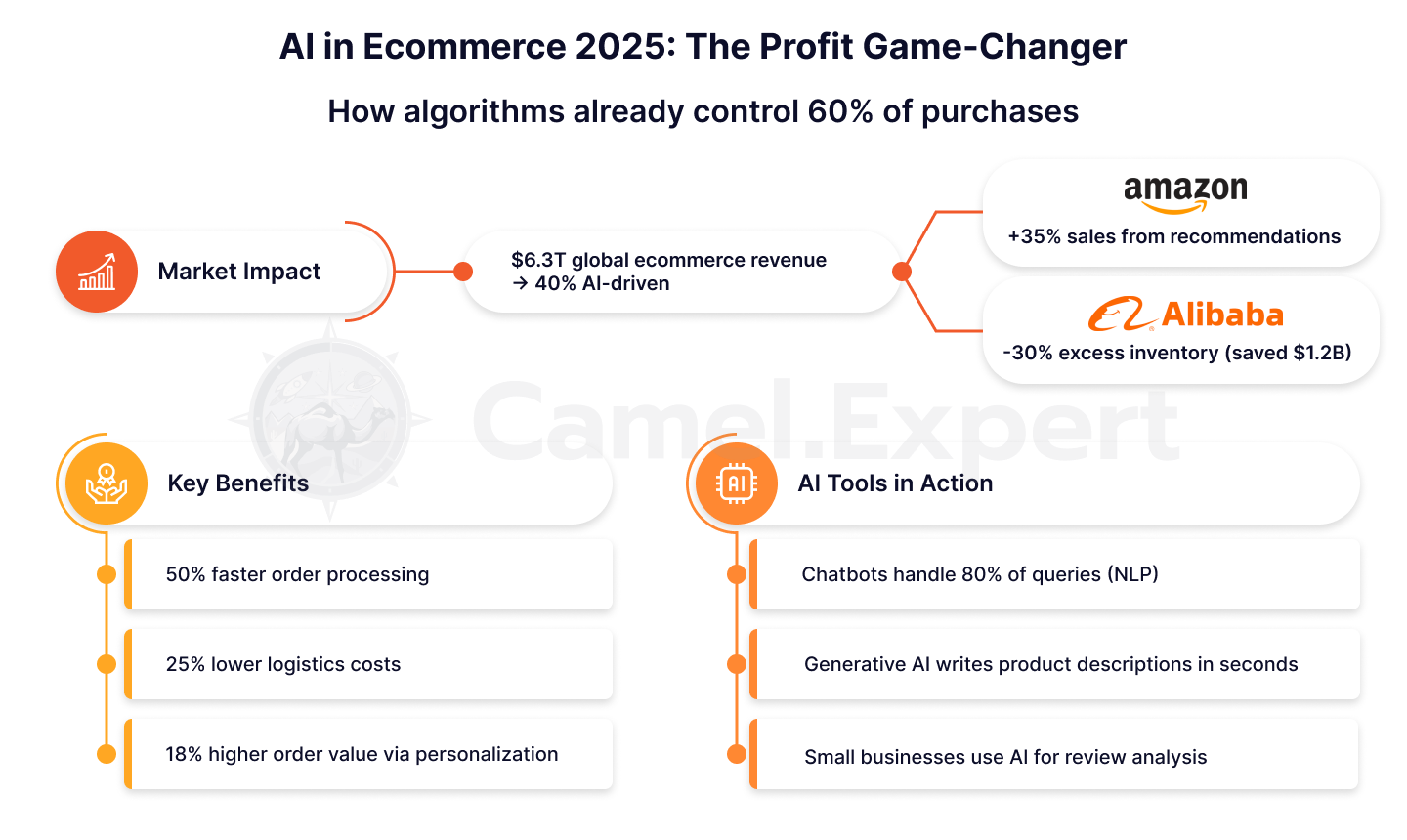
According to Statista, global ecommerce turnover will reach $6.3 trillion by the end of 2024, with 40% of this growth driven by AI technologies. Why? Because companies implementing AI are already reaping the benefits:
- 50% faster order processing;
- 25% reduction in logistics costs;
- 18% increase in average order value through personalization.
Take Amazon, the ecommerce giant that generates 35% of its revenue through AI recommendations. Retailers can use AI development and its algorithms analyze the behavior of over 300 million users, predicting desires before they even place an order. Or Alibaba: their demand forecasting system, based on machine learning in ecommerce, reduced excess inventory by 30%, saving $1.2 billion in a year.
AI Development is Not “Tomorrow,” It’s “Now”
“Are you still thinking AI is a distant future?” asks Jason Goldman, an MIT expert. While some debate, others act:
- Ecommerce platforms are implementing NLP chatbots that handle 80% of queries without human intervention;
- Retailers use generative AI enables creating product descriptions in seconds;
- Even small businesses are adopting ecommerce AI tools for review analysis and audience segmentation.
By 2024, AI technologies have become the lifeblood of ecommerce businesses. They manage supply chains, predict trends, and even create content. But how exactly do they help companies not just survive, but increase profits? More on that in the next chapter.
The Benefits of Using AI in Ecommerce: From Sales to Logistics
AI improves sales, reduces costs, and turns routine into innovation. If you’re still skeptical about the power of AI in ecommerce, these examples will change your mind.
Table 2: Manual Processes vs. AI Solutions
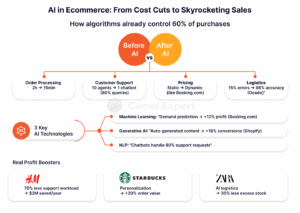
| Process | Without AI | With AI |
| Order processing | 2 hours for 100 orders | 15 minutes (automation) |
| Customer support | 10 operators | 1 chatbot (80% of queries) |
| Pricing | Static prices | Dynamic (e.g., Booking.com) |
| Logistics | 15% error rate in forecasts | 98% accuracy (e.g., Ocado) |
Key Types of AI and Their Applications: From Data to Profit
Machine learning, generative AI, and natural language processing (NLP) are the three pillars supporting modern solutions for ecommerce.
1. Machine Learning
Algorithms analyze terabytes of data to predict demand, optimize pricing, and identify purchasing patterns. For example, Booking.com uses machine learning for dynamic pricing: the system adjusts room rates in real-time based on seasonality, demand, and even weather. The result? A 12% increase in annual profits.
2. Generative AI
This AI tool creates texts, images, and videos for products. For instance, Shopify integrated generative AI into its platform: product descriptions are now generated in seconds, and conversion rates have increased by 18%.
3. NLP (Natural Language Processing)
NLP-powered chatbots understand customer queries at a human level. Imagine: instead of 10 support agents, you have one AI assistant handling 80% of inquiries.
3 Case Studies Where Artificial Intelligence Increased Profits by Millions
- H&M: Chatbots Reduced Support Workload by 70%
By implementing an AI assistant on their website, H&M automated responses to frequently asked questions about delivery and sizing. This saved the company $2 million annually and improved customer experience: 90% of users praised the speed of issue resolution. - Starbucks: Personalization Increased Average Order Value by 20%
Personalized product recommendations in the Starbucks mobile app are generated based on purchase history and location. Thanks to AI algorithms, customers are more likely to add desserts or seasonal drinks to their orders. - Zara: Flawless Logistics
Zara uses machine learning to forecast demand. The system analyzes sales across 2,000+ stores and automatically adjusts supply. The result: a 30% reduction in excess inventory and a 25% increase in inventory turnover.
Imagine your website processes 1,000 orders daily. Without AI, you spend hours manually checking data, risk pricing errors, and lose customers due to generic offers. With AI, you:
- Automate 60% of processes;
- Increase conversion rates by 15–30%;
- Reduce logistics and support costs.
But what awaits us in 2025? In just a year, AI will learn to predict customer desires before they click “buy.” Are you ready for this?
The Future of Ecommerce Industry: AI Ecommerce Use Cases in 2025
By 2025, ecommerce will transform into a digital ecosystem where AI manages every stage—from product discovery to delivery. If you think this is an exaggeration, here are three trends that will revolutionize the ecommerce industry in just a year.
Table 3: AI Trends 2025: Technologies and Their Impact
| Trend | Technology | Expected Impact by 2025 |
| AI Visual Search | Pinterest Lens, ASOS | +40% conversion for retailers |
| Autonomous Supply Chains | Alibaba Robots | -90% errors in logistics |
| Generative AI | Shopify Magic | -300 hours/month on content creation |
| Hyper-Personalization | ML Algorithms | +25% customer loyalty |
Trend 1: AI Visual Search — “Saw It? Bought It!”
“Take a photo of your friend’s dress—and our algorithm will find similar items.” This is how AI visual search works. For example:
- Pinterest Lens increased partner conversion rates by 20%, allowing users to search for products via photos.
- ASOS integrated visual search into its app: customers upload screenshots from social media, and AI suggests similar models. The result? A 15% reduction in returns due to better alignment with customer expectations.
How does this change the future? By 2025, 40% of search queries will be visual (Gartner, 2024). If your ecommerce website doesn’t support this feature, you’re losing customers who are already searching for products through their smartphone cameras.
Trend 2: Generative AI — Content in Seconds
“Generative AI can be used not only for text but also for video reviews,” stated the CEO of Shopify. Their tool, Shopify Magic, creates product descriptions, email campaigns, and even promotional videos. The results:
- Savings of 300+ hours per month on content creation;
- A 22% increase in conversion rates due to personalized descriptions.
Example: The startup GlowRoad automated the creation of product cards for 10,000 items using generative AI. The time to launch a product was reduced from 2 days to 20 minutes.
Trend 3: Autonomous AI-Powered Supply Chains — The Future of Logistics Without Human Intervention
Alibaba and Ocado are already using AI to manage their warehouses:
- Alibaba automated 90% of processes in its “smart warehouses.” AI-powered sorting robots reduced errors to 0.1%.
- Ocado (UK) processes 200,000 orders daily without human intervention. Their system predicts demand with 98% accuracy, minimizing excess inventory.
What will this lead to by 2025? Full autonomy: from order placement to drone delivery.
Warning: “Companies Without These Technologies Will Lose 30% of Customers”
According to a Gartner report (2024), by 2025, 30% of customers will switch to competitors if a website doesn’t offer AI visual search, personalization, or instant delivery. “The future of ecommerce belongs to those already experimenting with AI,” asserts analyst Lisa Myers.
But how to avoid mistakes during implementation? Should you try to build an AI solution in-house or rely on experts? The answer lies in the next chapter.
AI Implementation: Risks and Business Mistakes
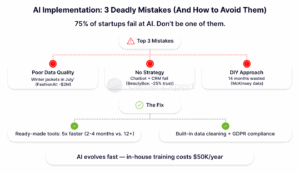
“75% of startups fail at AI implementation due to three fatal mistakes,” states a 2024 Gartner study. Artificial intelligence in ecommerce is not a magic pill but a complex tool. And if implemented without a strategy, the consequences can be catastrophic.
Top 3 Startup Mistakes: Why AI Projects Fail
- Poor Data Quality — Garbage In, Garbage Out
AI algorithms require high-quality data. The startup FashionAI attempted to implement a recommendation system but used uncleaned purchase data. The result? The AI suggested winter jackets to customers in July. Losses: $2 million and a 40% drop in audience. - Lack of Strategy — “Let’s Just Add AI!”
Companies adopt AI for the trend rather than to solve specific problems. For example, the retailer BeautyBox integrated a chatbot without connecting it to their CRM. Customers received conflicting delivery information, leading to 25% negative feedback. - DIY Approach — “We Can Do It Ourselves”
Attempting AI development from scratch without experts is like building a rocket using YouTube tutorials. The average ecommerce web development time for such projects is 14 months (McKinsey, 2023).
Table 4: Top 3 Mistakes vs. Solutions
| Mistake | Consequences | Solution |
| Poor Data Quality | -40% audience (FashionAI) | Data cleaning + Camel Expert |
| Lack of Strategy | -25% negative feedback | Process audit |
| DIY Approach | 14 months of development | Ready-made tools (3 months) |
The Solution: Why Ready-Made Ecommerce AI Tools Are 5x More Effective
Ready-made platforms like Salesforce Einstein or the best AI tools from Camel Expert solve three key problems:
- Time: Implementation in 2–4 months instead of 12+;
- Data Quality: Built-in data cleaning and analysis systems;
- Security: GDPR compliance and protection against leaks.
Example: The marketplace EcoGoods reduced AI analytics integration time from 10 months to 8 weeks by choosing Camel Expert. The result: a 45% increase in ROI within six months.
AI Technologies are Evolving — Will Your Team Keep Up?
“AI technologies are advancing so fast that yesterday’s knowledge is already outdated,” says Anna Kuznetsova, CTO of Camel Expert. Training your team in-house requires $50k+ annually and 300+ hours. Ready-made solutions include not only software but also expert support.
Use Cases of AI in Ecommerce: Why the DIY Approach Doesn’t Work
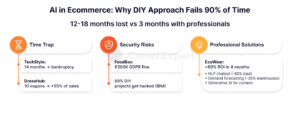
“Attempting to implement AI on your own is like playing Russian roulette: 90% of startups lose time and money,” states a 2024 Deloitte report. AI in ecommerce requires not just technology but also expertise. Why is the “do-it-yourself” approach a dead end?
Argument 1: Time is Your Biggest Enemy
On average, developing an AI solution from scratch takes 12–18 months. During this time, your competitor, working with professionals, will implement ready-made tools in 3 months and capture your market share.
Example:
The startup TechStyle spent 14 months creating its own recommendation algorithm. While the team struggled with errors, their competitor DressHub integrated an AI platform in 10 weeks. The result: DressHub increased sales by 55%, while TechStyle went bankrupt.
Rhetorical Question:
“How many customers will you lose in those 12 months?”
Argument 2: Security is Not a Place for Experimentation
DIY AI implementation often leads to data leaks and fines. For example:
- In 2023, the startup FoodBox paid €500,000 for GDPR violations due to incorrect processing of personal data by an AI model.
- 68% of DIY projects face cyberattacks due to vulnerabilities in homemade systems (IBM Security, 2024).
Modern ready-made solutions include:
- AES-256 data encryption;
- Automatic security updates;
- Legal support for GDPR compliance.
Table: DIY vs. Professional Solutions
| Parameter | DIY Approach | Professional Solutions |
| Timeline | 12–18 months | 2–4 months |
| Security | Risk of fines (GDPR) | Full compliance |
| ROI | 12% success rate | +60% (EcoWear example) |
| Support | None | 24/7 expert assistance |
Success Story: EcoWear + AI = 60% ROI Growth
The eco-clothing brand EcoWear decided to automate customer support and analytics. Within 4 months, they implemented:
- An NLP-powered AI chatbot, reducing operator workload by 80%;
- A demand forecasting system, optimizing inventory by 35%;
- Generative AI for creating eco-friendly content.
Results after one year:
- ROI increased by 60%;
- Website conversion rate grew by 25%;
- Savings of $200,000 on logistics.
How Much Are You Losing by Delaying Implementation?
While you’re reading this article:
- Your competitors are setting up personalized product recommendations;
- Customers are switching to those offering instant AI-powered support;
- The market is growing, and your share is shrinking.
According to Forbes, companies that delay AI adoption until 2025 will spend 50% more to catch up with industry leaders.
How to Start Today?
Instead of months of trial and error, follow a clear plan from professionals. In the next chapter, you’ll learn how to prepare your business for 2025 in 3 steps.
How to Prepare for 2025: A Step-by-Step Guide
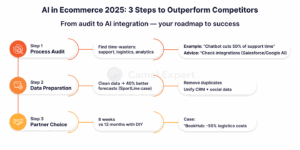
By 2025, using AI tools in ecommerce will be as essential as having a website. But to avoid falling behind, act today. Here are three steps to transform your business into a digital leader.
Step 1: Process audit – where is the routine hiding?
Step 1: Process Audit — Where is the Routine Hiding?
Create a checklist:
- Where do employees spend the most time (support, analytics, logistics)?
- Which processes can be automated with AI tools?
- Example: If customers ask the same questions, an NLP-powered chatbot can save 50% of operator time.
Tip: Check if your ecommerce platform integrates with AI solutions (e.g., Salesforce CRM or Google AI analytics).
Step 2: Data Collection — Fuel for AI
AI technologies only work with high-quality data. How to prepare it:
- Clean your databases: Remove duplicates and outdated records.
- Consolidate sources: CRM, social media, email campaigns—everything in one repository.
- Example: The brand SportLine increased demand forecast accuracy by 40% by structuring 5 years of purchase data.
Step 3: Choosing a Partner
DIY AI implementation comes with risks and months of trial and error. AI implementation companies offer:
- Ready-made Ecommerce AI tools: Implementation in 8–12 weeks instead of a year.
- 24/7 support: From integration to employee training.
- Case Study: The marketplace BookHub reduced logistics costs by 55% by integrating AI analytics.
Start with a Free Consultation
Experts at Camel Expert will audit your business and create a personalized AI implementation plan. While you’re hesitating, your competitors are already profiting.
AI in Ecommerce — Your Ticket to the Future
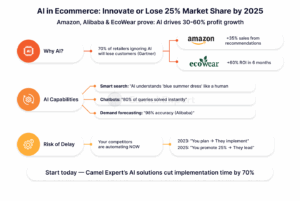
By 2025, the future of ecommerce will be defined by one question: Are you using AI in ecommerce or not? Artificial intelligence technologies are already changing the game: they predict demand, reduce costs, and create personalized experiences for millions of customers. As demonstrated by case studies from Amazon, Alibaba, and EcoWear, companies that have implemented AI have already increased profits by 30–60%.
Innovation or Failure — The Choice is Yours. According to Gartner forecasts, by 2025, 70% of retailers ignoring AI will lose at least 25% of their market share. Your competitors aren’t waiting: they’re automating processes, deploying chatbots, and optimizing logistics right now.
Conclusion
AI development is transforming the future of ecommerce, and its applications are reshaping how businesses operate. By leveraging AI and machine learning, ecommerce platforms can unlock new levels of efficiency and customer satisfaction. From personalized product recommendations that use AI algorithms to enhanced search capabilities on ecommerce websites, the use of artificial intelligence is revolutionizing the shopping experience. AI integration can help ecommerce retailers optimize inventory, forecast demand, and even create dynamic pricing strategies, ensuring businesses stay competitive.
Also, AI is revolutionizing the way ecommerce businesses operate, by offering smarter ways to enhance customer experience and increase sales. Today, many ecommerce sites are using artificial intelligence to optimize various aspects of their operations. From improving search functionality to providing personalized product recommendations, AI is being used to enhance customer engagement and boost conversions.
These product recommendations use AI algorithms to analyze customer behavior, preferences, and purchase history, ensuring more relevant suggestions. To fully leverage AI, businesses need to choose an AI solution that fits their needs and effectively train the AI model for optimal performance. Whether it’s optimizing pricing strategies or refining search results, AI development can help ecommerce retailers stay competitive in an evolving market.
The benefits of using AI in ecommerce development are undeniable. Companies leveraging AI tools can analyze vast amounts of data to understand customer behavior, predict trends, and tailor marketing efforts. Whether it’s implementing AI to streamline B2B ecommerce operations or using generative AI technologies to craft compelling product descriptions, AI offers in integration are becoming essential. Ecommerce businesses are using AI capabilities to improve decision-making, reduce costs, and deliver hyper-personalized experiences.
As advances in artificial intelligence and machine learning continue, the ability to train AI models and choose the right AI solution will be critical for success. By 2025, businesses that embrace AI tools and technologies will not only survive but thrive, turning challenges into opportunities and driving sustainable growth in the ever-evolving ecommerce web development niche.
Don’t put off until tomorrow what can bring profit today.
The Camel Expert team is ready to help you take the first step.
AI is not an expense—it’s an investment. Start turning data into money tomorrow. Your business deserves a future where technology works for you.
Checklist 1: Business Process Audit for AI Implementation
Goal: Identify routine tasks that can be automated using AI.
- Department Analysis:
Customer Support:
- How many inquiries are resolved with templates (order status, returns)?
- Is there a chatbot? If yes, what percentage of responses are automated?
Logistics:
- How often do demand forecasting errors occur?
- How much time is spent manually adjusting supply chains?
Marketing:
- How is content created (product descriptions, email campaigns)?
- Are personalized recommendations used?
Task Prioritization:
- Create a list of processes based on criteria:
- Time to complete;
- Frequency of errors;
- Impact on profit.
Example: Chatbot for support > Dynamic pricing > Content generation.
Platform Integration:
- Check if your ecommerce platform supports APIs for AI development and solutions (e.g., Shopify, WooCommerce).
- If not, create a technical specification for developers.
Tip: Use insights from Chapter 6 of this article—the EcoWear case study, where an audit reduced costs by 40%.
Checklist 2: Data Preparation for AI Development
Goal: Ensure high-quality data for training models.
Data Collection:
- What sources are used?
- CRM (purchase history, contacts);
- Social media (likes, comments);
- Logistics systems (delivery times, inventory).
- Example: The brand SportLine consolidated data from 5 sources into a single repository.
Data Cleaning:
- Remove duplicates and incorrect entries (e.g., orders with invalid emails).
- Check formatting (dates as DD/MM/YYYY, prices in one currency).
Data Structuring:
- Categorize data:
- Customer demographics;
- Behavioral patterns;
- Product categories.
- Use tools like Google BigQuery or Tableau.
Data Protection:
- Does storage comply with GDPR?
- Is encryption (AES-256) in place?
Tip: Before implementing machine learning, conduct an A/B test on a small data sample.
Checklist 3: Choosing Ecommerce AI Tools or a Partner
Goal: Find the optimal solution for your business.
Define Goals:
- What needs to be automated?
- Support (NLP chatbots);
- Logistics (demand forecasting);
- Marketing (generative AI).
Solution Comparison:
- Ready-Made Platforms (Salesforce Einstein, Camel Expert):
- Implementation time;
- Cost;
- Support (technical, training materials).
- Custom Ecommerce Development:
- Budget ($50k+);
- Timeline (6–18 months);
- Risks (coding errors, data leaks).
Security Check:
- Are there certifications (ISO 27001, GDPR)?
- How often is security updated?
Case Studies and Reviews:
- Request implementation examples from the provider (e.g., how Camel Expert helped EcoWear).
- Check ratings on G2 or Capterra.
Start with a Pilot Project:
- Choose one process to test (e.g., a chatbot).
- Measure ROI over 3 months.
Tip: If the budget is limited, start with AI tools for content (ChatGPT, Jasper) or analytics (Google Analytics AI).