Startup Business Plan: How to Build a Strategy That Convinces Investors and Outplays Competitors
A Business Plan Is Not a Document—It’s the Foundation of Your Success
“Startups with well-thought-out business plans attract 60% more investment,” according to Harvard Business Review. But if it’s so simple, why can’t 9 out of 10 startup founders clearly explain how their business plan for startup differs from a business plan outline downloaded online? The answer lies in the misconception that a business plan is just a formality—not a strategic tool. Consulting services business plan help you create a tailored, actionable strategy for success.
Imagine: Two EdTech startups enter the market.
Startup #1 copies a standard business plan template.
Startup #2 analyzes its target audience, builds financial models accounting for risks, and defines a Unique Selling Proposition (USP) that solves a real customer pain point.
Which one gets funding?
The statistics leave no doubt: Startup #2. The problem? Most founders, like Startup #1, stick to templates without adapting them to their goals. The result? 42% of startups fail due to lack of market demand (CB Insights).
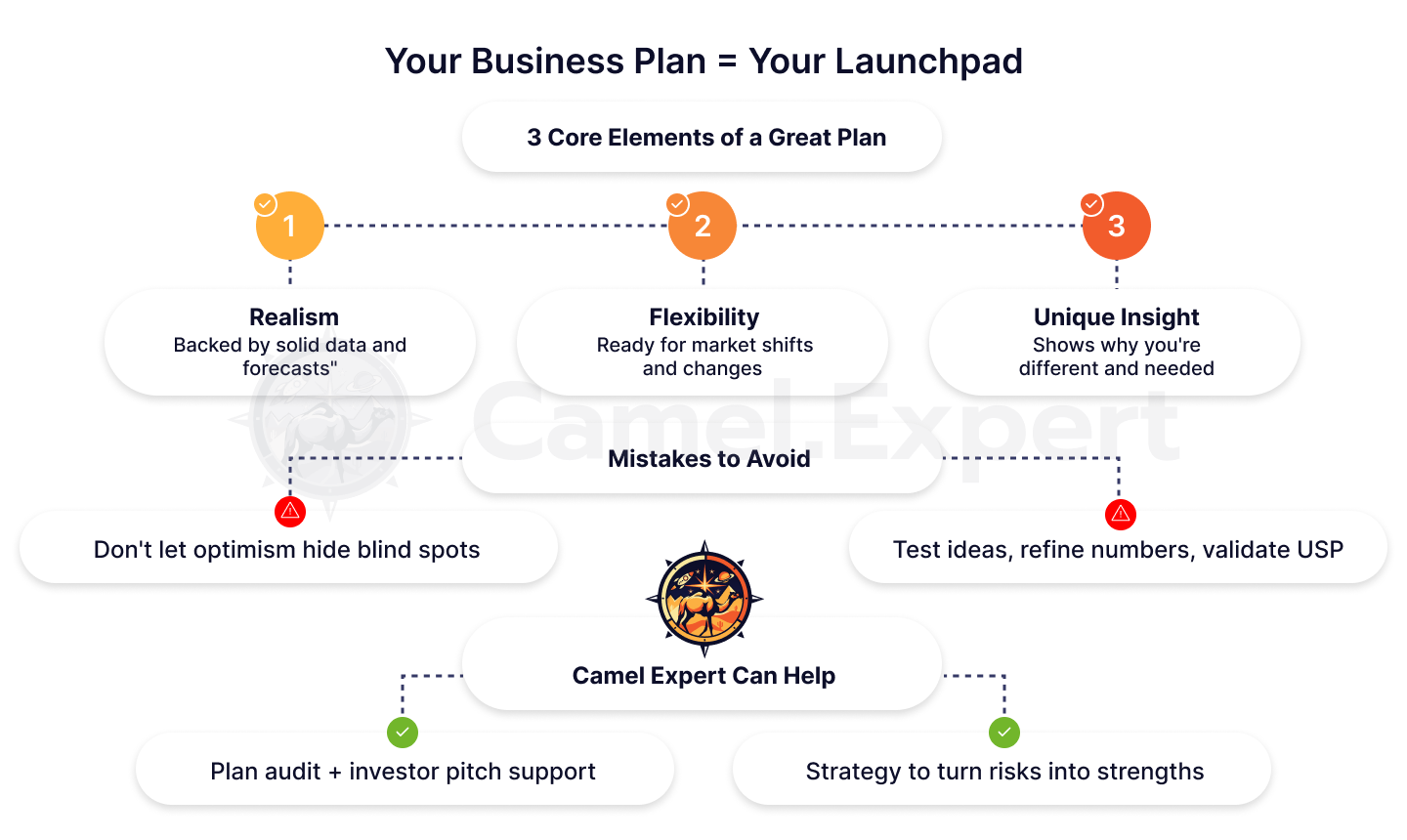
A successful startup business plan is not a document—it’s a combination of three elements:
- Analytics (market, competitor, and customer data).
- Strategy (clear steps to achieve goals).
- Audience understanding (how your product solves their problem better than others).
Take Quibi—a startup that raised $1.75 billion but shut down after 6 months. Their mistake? The business plan outline for startup assumed young audiences would pay for short-form video. Reality? Users preferred TikTok and YouTube. Had Quibi analyzed user behavior deeply, the collapse could’ve been avoided. This example shows how a flawed business plan outline can derail even the most well-funded venture. Consulting services business plan help avoid such pitfalls by ensuring a more informed, strategic approach to your startup.
Let’s Break It Down:
- How to turn a business plan from a “paper formality” into a competitive advantage? A key aspect of this transformation is incorporating break-even analysis.
- Which experts you need to create it (from analysts to patent attorneys). To create a business plan that attracts funding, you’ll also need legal, financial, and marketing insights.
- Why even a brilliant plan fails without 7 critical sections.
What Makes a “Magnificent” Startup Business Plan? Criteria That Set It Apart from Templates
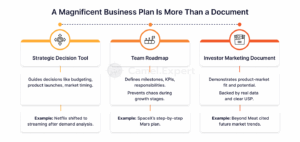
Imagine building a house. A template business plan outline for startup is like a generic blueprint from the internet—it accounts for windows and doors but won’t fit a sloped or earthquake-prone plot. A magnificent business plan, however, is a custom architectural plan tailored to terrain, materials, and your needs, involving strategic business planning for long-term success.
A Business Plan ≠ A Formal Report
A business plan is:
- A Decision-Making Tool
Answers: “Should we launch this product?”, “How to allocate budget?”, “Where to cut costs?”
Example: When Netflix shifted from DVDs to streaming, its plan didn’t just state the idea—it analyzed internet user growth and projected lower delivery costs.
- A Roadmap for Your Team
Clear stages, deadlines, and KPIs prevent chaos.
Example: In 2015, SpaceX published its Mars colonization plan. Despite its ambition, it included concrete steps: rocket tests, cost reduction, partner search.
- A Marketing Document for Investors
Doesn’t just ask for money—proves why your startup is a winning bet.
Example: Beyond Meat’s plan highlighted not just plant-based meat tech but also the eco-conscious trend: “By 2025, 30% of consumers will reduce animal protein” (Nielsen).
4 Signs of a Well-Crafted Business Plan
1. Flexibility: A Plan That Can Adapt
The market is unpredictable—pandemics, new technologies, sanctions. A thought-out plan includes adaptation scenarios.
Example: In 2007, Netflix started with DVD rentals but had a “Digital Future” section in its plan. When streaming demand surged, the company didn’t rewrite its strategy—it just updated the steps.
How to Check Your Plan’s Flexibility:
- Does it include scenarios like “What if demand drops by 40%?”
- How often do you review it? (Recommended: Every 3–6 months).
2. Data Over Assumptions: No “We Think” Statements
Templates are full of phrases like “We believe the market is huge.” A great plan relies on facts:
- Market research (Gartner, Statista, Frost & Sullivan reports).
- Customer surveys (polls, interviews, A/B tests).
- Competitor analysis (their weaknesses = your opportunities).
Esempio:
Before launching in the U.S., Oatly conducted 200 customer interviews. Their plan revealed: Customers would pay more for eco-friendly milk but wanted convenient packaging.
Result: Revenue grew 295% in 2 years.
3. Focus on USP: Why You’re Not Just Another Player
Your Unique Selling Proposition (USP) isn’t a product feature—it’s the benefit customers can’t get elsewhere.
Example: In 2006, Tesla didn’t sell EVs as “alternatives to gas cars.” Their USP: “Electricity isn’t about saving—it’s about superior speed and design.”
How to Define Your USP:
- Use this template: “We help [target audience] achieve [goal] by solving [problem] through [your differentiator].”
- Test it: If your USP could fit a competitor, it’s not a USP.
4. Risk Transparency: Don’t Hide Weaknesses
Investors value honesty over perfection. A great plan names risks and solutions upfront.
Example:When Revolut entered fintech, its plan included:
- Risk: Fierce competition from traditional banks.
- Solution: Focus on instant cross-border transfers—a feature Barclays/HSBC lacked.
How to Present Risks:
- Use a table: “Risk,” “Probability,” “Mitigation Steps.”
- Avoid vague terms like “cyberattacks” → Specify: “15% risk of DDoS attacks → Partner with Cloudflare.”
Table 1: 4 Traits of a Magnificent Business Plan
| Trait | Descrizione | Esempio del mondo reale |
| Flessibilità | Adapts to market changes with “what-if” scenarios. | Netflix’s 2007 “Digital Future” pivot to streaming. |
| Data-Driven | Uses market research, customer insights, competitor analysis. | Oatly’s 200 interviews pre-launch. |
| USP-Focused | Clearly defines what makes you unique. | Tesla’s “Speed & Design > Gas Cars” angle. |
| Risk-Transparent | Openly addresses risks with mitigation plans. | Revolut’s cross-border transfers vs. banks. |
Review Your Plan: 3 Critical Questions
- Can you explain every number in your financial model?
- Does your team know what milestones come next in 6 months?
- Have you clearly stated why your product is truly better than alternatives?
If the answer is “no” to even one question—go back to the draft. A great startup business plan isn’t about length; it’s about depth of analysis and honesty.
The Real Purpose of a Business Plan: 5 Unspoken Goals
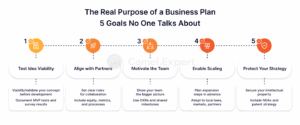
A well-crafted business plan isn’t just a template—it’s a flexible tool built on data, USP, and transparency. But why spend weeks creating one when a pitch deck seems enough? Because a business plan solves hidden challenges that often determine success or failure.
Obvious Goals (What Everyone Knows):
- Attracting investors.
Investors want to see not just an idea, but evidence of its viability. A business plan is your “Why us?” argument.
Example: When Elon Musk was seeking funding for SpaceX, his plan included not only technical calculations, but also an analysis of the costs of reusable rockets. The result? $1 billion in investment from NASA.
- Organizing Processes
A business plan for startup turns chaotic actions into a clear sequence of steps. Example: Trello used a business plan as a basis for Agile sprints at the start, which helped launch an MVP in 4 months.
But if that were all there was to it, 90% of startups wouldn’t ignore creating a business plan. Let’s dig deeper.
Hidden Goals: What Business Gurus Don’t Talk About
1. Testing Your Idea’s Viability
Before spending millions on development, verify if the world actually needs your product. A business plan serves as litmus test for your hypotheses.
Example: Dropbox In 2007, Drew Houston didn’t immediately build the product. Instead, he created a 3-minute explainer video about cloud storage and posted it on a forum. The video attracted 75,000 signups in one day, proving demand—which became a key investor argument in the business plan.
How It Works:
- Formulate a hypothesis (“People will pay for X”).
- Test it via MVP, surveys, or A/B tests.
- Document results in your plan.
2. Partner Negotiations: Avoiding Conflicts
Clear KPIs and role definitions in your business plan set the “rules of the game” for all stakeholders..
Example: WeWork and SoftBank. In 2019, SoftBank invested $4.4 billion in WeWork, but the deal turned into a scandal. The reason? WeWork’s business plan didn’t have clear growth metrics, such as the ratio of rental costs to revenue. This led to disagreements and a loss of $40 billion in market capitalization.
Cosa includere:
- Equity distribution.
- Dispute resolution process.
- Progress evaluation criteria.
3. Team Motivation: When Everyone Sees the Goal
Employees are 25% more productive (Gallup) when they understand the company’s direction. A business plan isn’t bureaucracy—it’s clarity.
Example: In 2010, Google spun off a team called Google X to work on “crazy” projects like self-driving cars. Their business plan included not only technical challenges but also a philosophy: “It’s okay to fail, but you can’t stand still.” This motivated engineers to take risks.
How to Implement:
- Show your team the sections of the plan that relate to their area of responsibility.
- Use OKR (Objectives and Key Results) to track goals.
4. Scaling Base: How to Grow Without Chaos
A business plan is a skeleton that acquires “muscles” as it grows.
Example: Uber. When entering a new country, their team did not start from scratch: the plan already included steps — analysis of regulations, partnerships with local taxi companies, PR strategy. This allowed them to scale up to 70 countries in 8 years.
What to add to the plan for scaling:
- Localized scenarios (for example, adapting a product to the EU GDPR).
- Franchising or partnership model.
5. Protection Against Copying: Lock Down Your Secrets
Unique strategies should be patented or kept confidential—both must be reflected in your plan.
Example: Coca-Cola. Their 1886 business plan included not just financial projections but a “Secret Formula” section. The recipe remains locked in a vault today, with millions spent annually on intellectual property protection.
How to Protect Yourself:
- Patent your technology (like Tesla did with batteries).
- Include NDAs (non-disclosure agreements) for partners in your plan.
Bottom Line: Your Startup Business Plan Is Your “Shield and Sword”
It doesn’t just attract funding—it also:
- Prevents failure by stress-testing your idea
- Simplifies negotiations through transparency
- Inspires your team by clarifying their mission
Now let’s examine how to structure a business plan that accomplishes all these objectives.
Anatomy of a Winning Business Plan: From Cover Page to Appendices
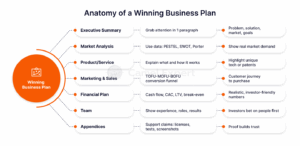
It’s time to dissect the “anatomy” of a business plan – from the first to the last section. How to turn dry data into a story that will win investors’ trust, and why the team section can be more important than financial forecasts.
1. Executive Summary: Your Startup in One Paragraph
This section is your plan’s first impression. If it doesn’t grab attention, the rest may go unread.
How to Write It:
- Problem: What’s wrong with the current market?
- Solution: How your product fixes it
- Market: Size and potential (research-backed numbers)
- Goal: Financial/social KPIs
Example Airbnb (2008):
“Airbnb solves the problem of expensive hotels and impersonal hostels by allowing people to rent out their spare homes to travelers. The short-term rental market is valued at $100 billion. Our goal is to reach $1 billion in revenue by 2025 through global expansion and partnerships with local communities.”
Tip: Write your resume last – this way it will more accurately reflect the essence.
2. Market Analysis: Facts, Not Guesses
Prove your product’s necessity using three frameworks:
- PESTEL (Political, Economic, Social, Technological, Environmental, Legal factors)
- SWOT (Strengths, Weaknesses, Opportunities, Threats)
- Porter’s Five Forces (Competition, New Entrants, Suppliers, Buyers, Substitutes)
Example Spotify:
When pivoting from music to podcasts, their analysis revealed:
- Social Trend: 40% of listeners prefer educational content (Nielsen)
- Technology: Smart speakers made audio more accessible
- Competition: Apple Podcasts lacked personalization
Bottom line: Spotify invested $500 million in exclusive podcasts (like Joe Rogan) and grew its audience by 30%.
3. Product/Service: Technology as Your USP
The product description must answer two key questions:
- What is it? (Simple explanation for non-technical readers)
- How does it work? (Technical details for investors and experts)
Example: SpaceX
“SpaceX develops reusable launch vehicles that reduce orbital delivery costs by 60%. The technology relies on Merlin engines capable of in-flight restart and an autonomous landing system.”
Critical note: If you have patents or unique algorithms—highlight them here.
4. Marketing & Sales: A Conversion Funnel That Works
Use the TOFU-MOFU-BOFU model:
- TOFU (Top of Funnel): Attraction via content, SEO, social media.
- MOFU (Middle of Funnel): Retention through webinars, email campaigns.
- BOFU (Bottom of Funnel): Sales via personalized offers.
Example for Slack:
- TOFU: Free articles about team productivity.
- MOFU: Webinars showcasing Slack implementation case studies.
- BOFU: Referral program: “Bring 3 teams—get 1 month free.”
Result: 80% of new customers came through word-of-mouth.
5. Financial Plan: Numbers That Convince
Investors want realism—not optimism. Include:
- Cash Flow Forecast: Where the money will come from and where it will go.
- Break-even analysis: Break even Point: When you will stop operating in the red.
- Scenarios: “What if sales drop by 20%?”
Business plan template for SaaS Startups:
- ARR (Annual Recurring Revenue): $500K in Year 1
- CAC (Customer Acquisition Cost): $150.
- LTV (Customer Lifetime Value): $900.
How to Verify: LTV Should Be At Least 3x Higher Than CAC
Table 2: Key Financial Metrics for Business Plans with Real-World Examples
| Metrico | What It Shows | Esempio del mondo reale | How to Calculate |
| CAC (Customer Acquisition Cost) | Cost to acquire one customer | Slack: Reduced CAC to $0.5 through referral program and virality | Total marketing spend / Number of new customers |
| LTV (Customer Lifetime Value) | Profit from a customer over entire relationship | Netflix: LTV = $623 (average subscription term — 4 years × $12,99/months). | Average purchase value × Average customer lifespan |
| Break-Even Point | When revenue covers fixed and variable costs | Tesla: Reached break-even in 2013 after Model S launch | Fixed costs / (Price per unit – Variable costs) |
| ARR (Annual Recurring Revenue) | Yearly recurring revenue (for subscription models) | Zoom: ARR grew from $100M (2018) to $2.6B (2021) due to pandemic | Sum of monthly subscriptions × 12 |
| ROI (Return on Investment) | Investment profitability | Beyond Meat: 700% ROI for investors post-IPO (2019-2020) | (Investment gain – Investment cost) / Investment cost × 100% |
6. Team: Why Investors Back People Over Ideas
Marc Andreessen, co-founder of Andreessen Horowitz, said: “We invest in teams that can turn a bad idea into a good one, and a good idea into a great one.”
How to Present Your Team:
- Experience: Even if not in your niche. Example: “Our CTO spent 5 years leading development at a bank but always dreamed of creating an EdTech product.”
- Roles: Clear responsibilities. Avoid “we all do everything together.”
- Achievements: “Our designer won a Red Dot Award” or “CEO’s previous startup had $10M exit.”
7. Appendices: Proof Over Promises
This section houses documents that validate your claims:
- Brevetti e licenze
- Market research (e.g., McKinsey reports)
- Client/partner testimonials
- MVP screenshots or early prototypes
Beyond Meat Example:
Their business plan appendices included blind taste test results showing 70% of participants couldn’t distinguish their plant-based burger from meat. This became a key investor pitch element.
Conclusion: Structure Is the Skeleton, Data Is the Soul
Even perfect structure fails without:
- Deep audience understanding (like Spotify)
- Technological edge (like SpaceX)
- Clear growth metrics (like Slack)
Only experienced professionals can help assemble this “puzzle” and avoid fatal mistakes.
What specialists are needed to create a startup business plan?
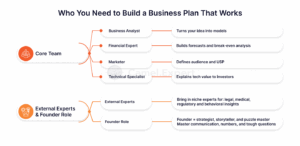
Creating a business plan is like solving a puzzle—even with all the pieces, you need the right “hands” and expertise to complete the picture. To create a business plan that actually works, you’ll need input from analysts, marketers, financial experts, and legal advisors. A clear business plan outline ensures all components are aligned—from market research to financial forecasting—and nothing critical is overlooked.
1. Key Roles and Responsibilities
Business Analyst: The Idea-to-Reality Translator
Their job: Turn your “We want to change the world” into concrete data and models.
What they do:
-Collect market data (size, growth, segments)
-Build business models (e.g., Canvas)
-Analyze competitors (their weaknesses = your opportunities)
Esempio:
Airbnb’s analysts discovered 80% of users distrusted peer-to-peer rentals. Solution? Added a plan section about professional photography partnerships to improve listing quality.
Financial Expert: Your Profit Architect
They know how to turn investment (“input”) into revenue (“output”).
What they do:
– Calculate break-even points through a break-even analysis to determine when your business will stop operating in the red and start generating profit.
- Build cash flow projections
- Assess risks (e.g., 30% demand drop)
Esempio:
When Spotify entered podcasts, their financial expert proposed premium subscriptions over ad-based monetization, increasing user LTV by 40%.
Marketer: The Voice of Your Product
They answer the critical question: “How will you win customers’ hearts and wallets?”
What they do:
–Segment your target audience (gender, age, pain points)
-Develop sales funnels (TOFU-MOFU-BOFU)
-Analyze acquisition channels (SEO, targeted ads)
Esempio:
Glossier’s marketers conducted 500 interviews with cosmetics buyers. Result? The brand’s USP—”Beauty without rules”—and 90% user-generated content.
Technical Specialist: Bridging Idea and Execution
Essential for IT solutions or complex technologies.
What they do:
–Define technical requirements (tech stack, development timelines)
-Calculate R&D costs
-Explain to investors why your product can’t be copied in a month
Esempio:
In SpaceX’s business plan, Elon Musk included a section where engineers detailed how reusable rockets would slash launch costs. Without this, investors wouldn’t have believed the idea was feasible.
2. When to Bring in External Consultants?
Even strong teams have gaps. Here’s when to seek outside experts:
- Niche Markets
For a pharma startup, you’d need consultants with medical expertise and FDA regulation knowledge.
- Legal Aspects
Patent attorneys help protect IP (like Coca-Cola’s secret formula).
- Behavioral Analytics
Facebook hired psychologists to study why people scroll feeds instead of socializing. These insights became a key ad-sales argument in their business plan.
3. Founder Skills: What You Must Master
Even if you delegate 80% of the work, these are non-negotiable:
Analytics: An Ability to See Data Beyond Emotions
- How to apply:
— Use Excel/Google Sheets for initial calculations.
— Learn core metrics: CAC, LTV, ROI. - Esempio:
Elon Musk personally checked every number in SpaceX’s financial model. His question: “Why is the launch cost exactly $60 million and not $50 million?” helped reduce costs by 30%.
Communication: Selling Your Idea in 2 Minutes
- How to apply:
-Practice your elevator pitch: “We help [target audience] solve [problem] through [your differentiator].”
-Learn to listen. Investors often drop hints like: “What if you offered subscriptions instead of one-time purchases?”
- Esempio:
Rent the Runway founder Jennifer Hyman started her pitch with a story: “Imagine being able to wear designer dresses for 10% of the price.” It worked — the company raised $125 million.
Critical Thinking: The Art of Asking Tough Questions
- How to apply:
— Stress-test your idea: “What could kill us in 6 months?”
— Challenge assumptions: If you say “Our market grows 20% yearly,” ask “What if it’s a bubble?” - Esempio:
When Airbnb’s growth slowed, Brian Chesky asked: “What 10 factors block our scaling?” The answers reshaped their plan.
Conclusion: Build a Team That Complements Your Weaknesses
A stellar business plan isn’t solo work—it’s a collaboration of analysts, marketers, and tech experts. As founder, your role is to orchestrate:
- Delegate tasks outside your strengths.
- Bring in niche consultants.
- Hone skills to become a versatile leader.
Self-Check:
- Does your team include someone who can explain why your CAC beats competitors?
- Do you know which plan sections to outsource?
3 Business Plans That Redefined Markets
Let’s look at how these principles work in reality. Three companies — Tesla, Beyond Meat, and Zoom — didn’t just create successful products. They managed to create a business plan that rewrote the rules of their industries. These plans became roadmaps for revolutions.
1. Tesla (2006): Conquering the Market Starting from a Niche
In 2006 году Elon Musk published a “Secret Tesla Plan” seemed insane::
- Goal: “Accelerate the world’s shift to sustainable energy.”
- Strategy:
Step 1: Expensive sports electric car (Roadster) for enthusiasts.
Step 2: Premium sedan (Model S) for the middle class.
Step 3: Mass electric car (Model 3) for everyone.
Why it worked:
- USP: Tesla wasn’t selling cars, it was selling “electric vehicle superiority” — speed, design, eco-friendliness.
- Financial model: The Roadster’s profits ($250,000 a pop) funded the development of the Model 3.
- Flexibility: When demand for the Model 3 exceeded expectations, the plan was adapted to accommodate the construction of the Gigafactory.
Result: Tesla’s market capitalization reached $1 trillion, and they own 70% of the electric vehicle market (BloombergNEF data).
2. Beyond Meat: How to Turn a Niche into Mainstream
In 2009, Ethan Brown founded Beyond Meat with the idea: “Plant-based meat should taste better than the real thing.” The company’s business plan included:
- Market Analysis:
— 300% growth in the number of people becoming vegetarians over 5 years (GlobalData).
— 40% of Americans are willing to reduce meat consumption (Nielsen). - USP: A plant-based burger that “bleeds” like beef (thanks to beet juice).
- Go-to-Market Strategy: Partnerships with fast-food chains (Subway, KFC) instead of retail stores.
Perché ha funzionato:
- Viability Test: Blind tests showed 70% couldn’t distinguish Beyond Burger from real meat.
- Marketing: Focus on sustainability (“99% less CO₂ emissions than beef”).
Result: The company’s 2019 IPO was valued at $1.5B, and McDonald’s launched its McPlant line.
3. Zoom: How to Scale Without Massive Costs
When Eric Yuan founded Zoom in 2011, the video communication market seemed saturated (Skype, Cisco). But his business plan changed the game:
- Technology: Cloud-based platform with ultra-low latency (<100ms) even on weak internet connections.
- Financial model:
— Freemium: Free 40-minute calls → massive user adoption.
— Monetization: Paid business subscriptions ($15/month per user). - Risk analysis: “What if big players will copy us?” → Answer: Focus on user-friendly interface.
Perché ha funzionato:
- Flexibility: During the pandemic, Zoom added features for schools and hospitals within a week.
- Scalability: Cost per user was just $0.01, enabling profitable growth.
Result: In 2020, revenue grew 326%, and daily users skyrocketed from 10M to 300M.
What Do These Business plan Examples Have in Common?
- Clear USP – Not just “another product,” but a solution to a global problem.
- Data-driven decisions – Market analysis, tests, metrics (no guesswork).
- Financial discipline – Even Tesla, which was unprofitable for years, strictly followed its phased plan. Among business plan examples, it stands out for long-term clarity, investor trust, and execution discipline.
How to Apply Their Lessons:
- If you’re a niche startup → Follow Tesla’s path: Start small but ambitious.
- If your product seems “weird” → Take a page from Beyond Meat: Turn a perceived weakness (not real meat) into a strength (eco-friendliness).
- If competitors seem unbeatable → Copy Zoom’s playbook: Find their weak spot (Skype’s clunky interface) and make it your advantage.
These companies proved: A business plan isn’t bureaucracy—it’s a weapon.
Mistakes That Turn Business Plans into Garbage
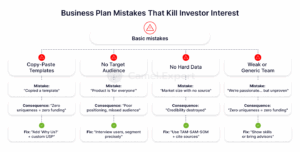
Even the most ambitious startup can fail if its plan is built on illusions. What happens when founders ignore basic principles?
1. “We Just Copied a Template” – Investors Spot This in 5 Minutes
Online templates are like fast food: quick and cheap, but useless for your startup’s health.
Example of Failure: In 2017, esports streaming startup Juked pitched a plan that was 90% identical to Twitch’s. Result? Zero funding. Investors said: “You didn’t explain how you’re different—just your logo color.”
How to Avoid:
- Use templates as a starting point, but customize every section for uniqueness.
- Add a “Why Us?” section missing from standard templates.
2. “Our Product Is for Everyone” – Why This Kills Even Great Ideas
“An app for everyone” = “An app for no one.” Without a defined target audience (TA), you’ll burn cash.
Example of Failure: Quibi spent $1.75B on short-form video “for millennials” but ignored that this audience prefers free TikTok. Result: Shut down in 6 months.
How to Avoid:
- Segment your TA. Instead of “men 20–40,” try “tech-savvy 25–35-year-olds willing to pay for exclusive gaming content.”
- Interview 20+ potential customers before drafting your plan.
3. “Our Market Is Huge” – Unsubstantiated Numbers = Red Flag
Claims like “$100B market” without research citations destroy credibility.
Example of Failure: Theranos claimed the medical testing market was “$75B” but cited no source. Later exposed: The number was made up. Result? Collapse and lawsuits.
How to Avoid:
- Use reputable sources (Statista, Gartner, Frost & Sullivan).
- Calculate TAM-SAM-SOM:
— TAM (Total Addressable Market): $50B (all smartphone users).
— SAM (Serviceable Available Market): $10B (users willing to pay for premium apps).
— SOM (Serviceable Obtainable Market): $500M (your share in 3 years).
4. “We’re Enthusiasts”: Why Investors Run from Such Teams
Investors back people who know how to execute ideas. The phrase “We’re enthusiasts” sounds like “We don’t know how to do this.”
Example of failure: The startup Juicero offered juicers for $700, and in the team section they wrote: “We are inspired by a healthy lifestyle.” But none of the founders had experience in hardware development. The result? The device simply crushed the bags, which could have been squeezed by hand anyway. The company closed, losing $120 million.
How to Avoid:
- Even without niche experience, highlight transferable skills:
“Our CEO led IT products at a bank for 5 years—he knows how to build complex systems.”
- Add consultants: “Consulted by John Smith, ex-R&D Director at Samsung.”
Table 3: Top Business Plan Mistakes & Fixes
Errore | Consequence | Soluzione |
Copying templates | Investors see lack of uniqueness → funding denied. | Add a “Why Us?” section with USP and competitor analysis. |
Ignoring TA | Failure due to poor positioning (like Quibi). | Conduct 20+ customer interviews and segment your audience. |
No hard data | Investor trust erodes (see Theranos). | Utilizzo TAM-SAM-SOM and cite Statista/Gartner. |
Weak team | Investors doubt execution (like Juicero). | Show team expertise or hire advisors (e.g., ex-R&D lead). |
Key Insight: Don’t Let Your Idea Drown in Clichés
These mistakes share one trait: they turn plans into empty words. Investors review hundreds of plans yearly—they spot templates and fluff instantly.
How to Test Your Plan::
- Give it to a non-industry colleague. Do they grasp your business?
- Remove all adjectives (“unique,” “revolutionary”). Is anything concrete left?
- Ask: “If I were an investor, would I believe this plan?”
As Y Combinator’s Paul Graham said: “The most successful startups often seem like bad ideas at first—but their plans are always rooted in facts, not fantasies.”
A Business Plan is Your Ticket to a World of Great Opportunities
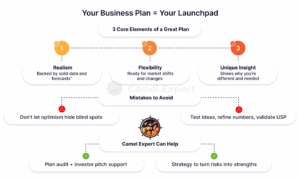
A great startup business plan is not a glossy brochure with perfect graphs. It is a living document that combines three elements:
- Realism (data-backed numbers).
- Flexibility (adapting to market shifts).
- Unique insight (why you’re not “just one of many others”).
As Tesla, Beyond Meat, and Zoom have shown, this is the approach that turns startups into game-changing companies.
But even the boldest ideas need to be tested. You can miss a flaw in the financial model, overestimate demand, or underdevelop the USP. And you don’t have to go it alone.
The Camel Expert Team will help you with:
- Conduct an audit of the business plan and find “blind spots”.
- Prepare convincing arguments for investors.
- Build a strategy that will turn risks into opportunities.
Remember: Airbnb started with a 10-slide deck, and Slack started with a simple internal chat. Their success wasn’t in the volume of documents, but in the fact that behind every number was a viable idea, backed by analysis and passion.
As Peter Drucker said, “Planning is the art of turning dreams into schedules and budgets.” Your business plan is the first step to turning your dream into a roadmap. Keep it simple – start small, but do it today.
Appendice
Checklist 1: “14 Steps to Create a Breakthrough Business Plan”
(Verify each item before investor meetings)
I. Data Preparation (Research & Analysis)
- ✅ Have you conducted at least 20+ customer interviews?
Esempio: Oatly did 200 interviews to learn customers would pay more for eco-friendly milk but wanted convenient packaging. - ✅ Have you collected data from 3+ reputable sources (Statista, Gartner, Nielsen)?
How to check: If the plan contains the phrase “Market – $X billion”, there should be a link to the research next to it. - ✅ Have you done a SWOT analysis of your competitors?
Modello:- Competitor strengths: Free shipping
- Their weaknesses: Clunky app UX
- Your opportunities: Simplify UX.
- Threats: Amazon entering your niche.
II. Strategy and USP
- ✅ Defined USP using this formula:
“We help [target audience] achieve [goal] by solving [problem] through [your differentiator].”
Example (Tesla): “We help drivers surpass gas cars in speed/design through electric engines.”
- ✅ Defined USP using this formula:
- ✅ Have you included at least 3 adaptation scenarios in your plan?
- Optimistic: Market grows 20%
- Realistic: 5% growth
- Pessimistic: 15% decline (e.g., pandemic)
- ✅ Have you written a scaling plan?
Options: Franchising (McDonald’s), partnerships (Uber + Spotify), global expansion (like Zoom).
III. Finance & Risks
- ✅ Calculated key metrics:
- CAC (Costo di acquisizione del cliente) ≤ LTV/3 (Lifetime Value per Customer).
- Break-even Point: Date when revenue covers expenses.
- ✅ Added the “Risks” section in table format:
| Rischio | Probability | Soluzione |
| 30% demand drop | 25% | Price cuts + new tier |
- ✅ Have you checked for unrealistic forecasts?
Errore: “We will capture 50% of the market in a year” → Correction: “We will occupy 5% of niche X in 2 years (according to Frost & Sullivan)”.
IV. Team and documents
- ✅ Have you shown the team’s expertise?
Bad: “We are enthusiasts”.
Good: “The CTO worked at Microsoft on cloud solutions for 5 years”.
- ✅ Included in the appendices:
- Patents/licenses.
- Letters from beta testers.
- MVP screenshots (like Dropbox).
- ✅ Have you crash-tested the plan?
Ask yourself: “What will kill us in 3 months?” → Add the answer to the risks section.
V. Presentation for investors
- ✅ Wrote a summary (Executive Summary) according to the scheme:
- Problem: “People spend 2 hours a day looking for parking.”
- Solution: “Mobile application with AI search for free spaces.”
- Market: “$10 billion, growth of 12% per year (J’son & Partners)”.
- Goal: “$1 million in revenue by 2024.”
- ✅ Removed all adjectives like “unique” and “revolutionary”?
Replacement: Instead of “Our unique product” → “Our solution reduces the time it takes to find parking by 70% (according to tests).”
Checklist 2: “Step-by-Step Business Plan Audit – 25 Questions That Will Save Your Startup”
(Avoid failures like Quibi or Juicero by reviewing each section carefully)
I. Market & Target Audience Analysis
- ✅ TAM-SAM-SOM:
- TAM (Total Addressable Market): Example: “All smartphone owners – 5B (Statista, 2023).”
- SAM (Serviceable Available Market): Example: “People willing to pay for premium apps – 1.2B.”
- SOM (Serviceable Obtainable Market): Example: “0.1% of SAM in 2 years – 1.2M users.”
- ✅ Competitor Analysis Depth:
- Includes a comparison table with 5+ criteria (price, features, sales channels).
- Highlights competitors’ weaknesses you can exploit. Example: “Company X lacks Telegram integration.”
- ✅ Customer Segmentation:
- Goes beyond demographics (age, gender) to psychographics (fears, goals).
- Example: “Mid-level managers who hate routine and value automation.”
- ✅ Demand Validation:
- Supported by A/B tests, surveys, or MVP results. Example: “500 people signed up for the beta in one week.”
II. Product & USP
- ✅ USP is formed by the formula:
“[Product] helps [Target Audience] achieve [Goal] through [Unique Differentiator], unlike [Competitor].”
Example (Zoom USP): “Zoom helps teams conduct lag-free meetings via a cloud platform with <100ms latency, unlike Skype.”
- ✅ USP is formed by the formula:
- ✅ Technological Advantage:
- Patents, unique algorithms, or team expertise.
Example: “Our algorithm reduces device energy consumption by 40% (Patent #XXXX).”
- Patents, unique algorithms, or team expertise.
- ✅ Product Roadmap:
- Clear 1-3 year development timeline with deadlines. Example: “Q3 2024: launch AI-assistant; Q1 2025: integration with Meta”.
III. Finance & Metrics
- ✅ Financial Model Includes:
- Cash Flow (monthly liquidity tracking)
- P&L (Profit & Loss statement)
- CAPEX/OPEX (Capital & Operational Expenses)
- ✅ Unit Economics Calculation:
- CAC = = Marketing Spend / New Customers Example: $150
- LTV = Avg. Purchase Value × Customer Lifespan Example: $900
- LTV:CAC ≥ 3:1. If lower, revise strategy.
- ✅ Stress-Test Scenarios:
- “What if CAC increases by 50%?”
- “What if conversion drops to 1%?”
- ✅ Break-Even Point:
- Calculated using the formula: Fixed Costs / (Price – Variable Costs per Unit).
Example: “600 sales per month will cover costs.”
- Calculated using the formula: Fixed Costs / (Price – Variable Costs per Unit).
IV. Marketing & Sales
- ✅ Sales Funnel:
- TOFU (top): Content, SEO, webinars. Example: Free checklist “How to Save 10 Hours/Week”
- MOFU (middle): Email-рассылки, case studies. Example: “Case Study: How Company Y Automated Reports”
- BOFU (bottom): Demos, personalized discounts. Example: “$1 Trial for 14 Days”
- ✅ Acquisition Channels:
- Ranked by ROI. Example: 1. Organic PR (ROI 300%), 2. Targeted Ads (ROI 120%)
- ✅ Retention Plan:
- Loyalty programs, dedicated account managers, regular updates.
V. Team & Risks
- ✅ Team Expertise:
- Relevant experience is indicated (even if not in this niche). Example: “CTO developed payment systems in a bank for 5 years.”
- ✅ Consultants & Partners:
- Список экспертов с регалиями. Пример: “Консультирует Jack Richards, ex-COO Intel”.
- ✅ Risk Matrix:
| Rischio | Probability | Impact | Mitigation |
| New GDPR Regulation | 30% | $500K fine | Hire EU compliance lawyer |
- ✅ Succession Plan:
- Key role backups identified
Example: “Deputy CEO – Anna Sidorova (10 yrs in management)”
VI. Documents & Appendices
- ✅ Legal Docs:
- Patents, licenses, certificates. Example: “ISO 27001 Certification (Data Security)”.
- ✅ Proof of demand:
- Customer letters, beta-test screenshots, survey results.
- ✅ Financial reports:
- Audited statements from an independent company if available. Example: “KPMG Audit Report 2023”
VII. Investor Pitch
- ✅ Executive Summary:
- Did you fit into 1 page? Check the structure:
- Problem → Solution → Market → Financial Goal → Team.
- Did you fit into 1 page? Check the structure:
- ✅ Visuals:
- Growth charts, USP infographic, product photos.
- ✅ Ответы на «неудобные» вопросы:
- “Why you? What’s your edge? How defendable is this?”
- ✅ Elevator Pitch Test:
- Can you explain the business in 30 seconds? Example: “We reduce recruitment time from 2 weeks to 1 day through AI.”
Evaluation criteria:
- Excellent: 23-25 checkmarks. The plan is ready to present to investors.
- Needs improvement: 15–22 галочки. Проверьте разделы с ❌.
- Danger: Less than 15. Risk of repeating Quibi’s path.
Mancia: If there are less than 4 checkmarks in the “Finance” section, contact a Camel Expert.
As Richard Branson said: “If your plan doesn’t scare you, it’s not ambitious enough.” But ambitions should be supported by numbers, not dreams.